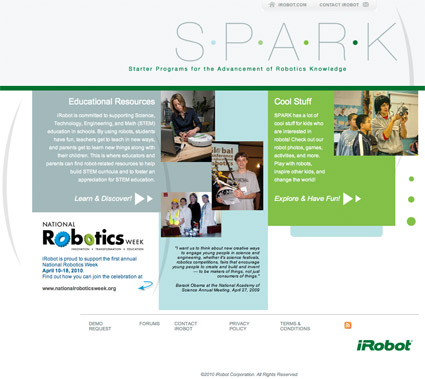
Stavo cercando di realizzare una raccolta di link ragionata sulla robotica didattica da inserire prossimamente anche sul mio account delicious, tra le varie risorse sto analizzando in questa serata: SPARK – Starter Programs for the Advancement of Robotics Knowledge, il sito che iRobot ha creato per il supporto allo studio della robotica nella scuola, i link sono moltissimi e possono essere di grande aiuto soprattutto perché la suddivisione è stata fatta per livello scolastico e per ogni livello trovate risorse per l’insegnante, esperienze e molto altro.
Ecco un modellino di elicottero/robot controllato mediante il display dell’iPhone via wifi.
Il robot ha incorporato una telecamera e sensori ad ultrasuoni che consentono prendere il pieno controllo dell’elicottero. Per maggiori informazioni visitate il sito: ardrone.parrot.com dove trovate molti video e cosa ancora più interessante potete prelevare tutta la documentazione necessaria per programmare il robot.
La scorsa serata, dopo l’n-esimo tutorial sull’uso di Roomba ad amici e la mia lezione sull’uso della robotica in campo didattico i ragionamenti hanno preso la strada del futuro analizzando i possibili sviluppi in campo domestico che i robot potranno avere nel prossimo decennio.
Le mie affermazioni su robot che lavano i vetri o che tinteggiano case sembravano troppo fantascientifiche, immaginare automi che potessero contrastare in modo semplice la forza di gravità sebrava qualcosa di impossibile, ma il filmato allegato ha fatto cambiare opinione.
Nel filmato potrete vedere:
un robot magnetico in grado di arrampicarsi su superfici metalliche;
una lumaca-robot che sfrutta l’uso di colla a caldo per arrampicarsi alle pareti;
un robot che sfrutta nastro adesivo su ruote e può salire su superfici lisce come una lavagna o vetro;
robot a 4 zampe che utilizza artigli realizzati con ami da pesca in modo da avere unghie simili a quelli di un gatto o ad un topo, in grado di scalare superfici ruvide.
la serata si è conclusa con la visione di Io Robot…
per me è stata la sedicesima visione del film 🙂
Lo scorso anno scolastico i robot esapodi hanno riscosso molto successo tra i miei allievi e quindi sto cercando risorse web dove poter attingere per la realizzazione di nuovi progetti basati su questa tipologia di robot. Un mio allievo mi ha segnalato i quattro video che vi allego sono estremamente interessanti.
Dal Robotic Locomotion Grup del MIT computer science and artificial intelligence laboratori (CSAIL) vi propongo il filmato di LittleDog un robot quadrupede in grado di percepire la struttura degli ostacolini che incontra ed adattare il suo movimento.
Researchers at places like MIT have been using Boston Dynamics‘ LittleDog robot for years now as a testbed to teach legged robots to learn how to traverse variable terrain on their own. This video shows some highlights of a “dynamic double-support gait,” which means (as near as I can tell) that LittleDog is supporting itself, at times, on only two of its four legs. This is a substantially more efficient way of negotiating terrain than we first saw two years ago. LittleDog also demonstrates some markedly biological ways of negotiating obstacles (with the possible exception of the belly flop on the Jersey barrier)… I especially liked how it pranced in place slightly before tackling each stair. All this stuff is obviously a lot of work for a little bot, since poor LittleDog completely collapses at the end of every test.
LittleDog, remember, is teaching itself the most efficient way to negotiate these surfaces. Overhead cameras examine the terrain and plan out LittleDog’s route by computing a ‘cost’ for each step, which takes into account the distance moved towards the goal as well as the potential for a fall. After a lot of trial and error, LittleDog figures out how to best compromise between progress and stability, and the lessons it learns could be propagated up to other, larger quadruped robots.
This video is from Phase 2 of DARPA’s Learning Locomotion program… MIT’s LittleDog team was awarded funding for Phase 3 of this program back in 2008, so we’ll keep you updated.